
Industrial water treatment in Penang is moving towards more carefully specified chemicals, closer process monitoring and more defensible water-use decisions. For manufacturers, the real priority is not to buy the latest formulation. It is to solve a clearly identified water-quality problem while protecting equipment, controlling operating risks and meeting the requirements that apply to the facility.
A cooling tower, an industrial effluent treatment system and a high-purity process-water line serve different purposes. Their chemistry, acceptable impurities and operating controls cannot be treated as interchangeable. This guide examines the developments that matter to Penang’s factory engineers, EHS teams and procurement managers, with practical examples of how to assess each option before requesting a quotation.
What is changing in industrial water treatment chemical selection?
Buyers are placing greater emphasis on application fit, measurable performance, water efficiency and traceable supply. These are useful directions for evaluating treatment programmes; they do not establish that every Penang factory has already adopted the same technology. The suitable approach depends on the water source, process conditions, treatment objectives and available expertise.
Consider an effluent treatment plant that produces inconsistent clarified water. A different coagulant might help, but so might better influent equalisation, pH control or separation equipment. The team needs to establish the cause before changing its chemical programme. Otherwise, a promising laboratory result could create difficulties elsewhere in the treatment train.
| Area of development | Practical objective | Evidence to request |
|---|---|---|
| Application-specific chemistry | Treat the actual contaminants without disrupting downstream processes. | Water analysis, product specification and representative trial results. |
| Lower-impact formulations | Assess chemical use, residuals and overall environmental consequences. | Product-specific claims, treatment results and waste-stream assessment. |
| Digital monitoring | Respond more consistently to changing operating conditions. | Sensor reliability, control logic and recorded baseline performance. |
| Water reuse and efficiency | Match treated water to a defined reuse application. | Water balance, required reuse quality and residual-management plan. |
| Quality and supply assurance | Maintain consistent purchasing and safe chemical handling. | Applicable SDS, product grade, batch records and delivery terms. |
Trend 1: Match treatment chemicals to the actual water chemistry
Effective chemical selection starts with a defined treatment duty and representative water analysis. The same chemical may behave differently when pH, alkalinity, suspended solids, dissolved metals or competing substances change. Engineers therefore need to consider both the contaminant they want to remove and the conditions under which the treatment will operate.
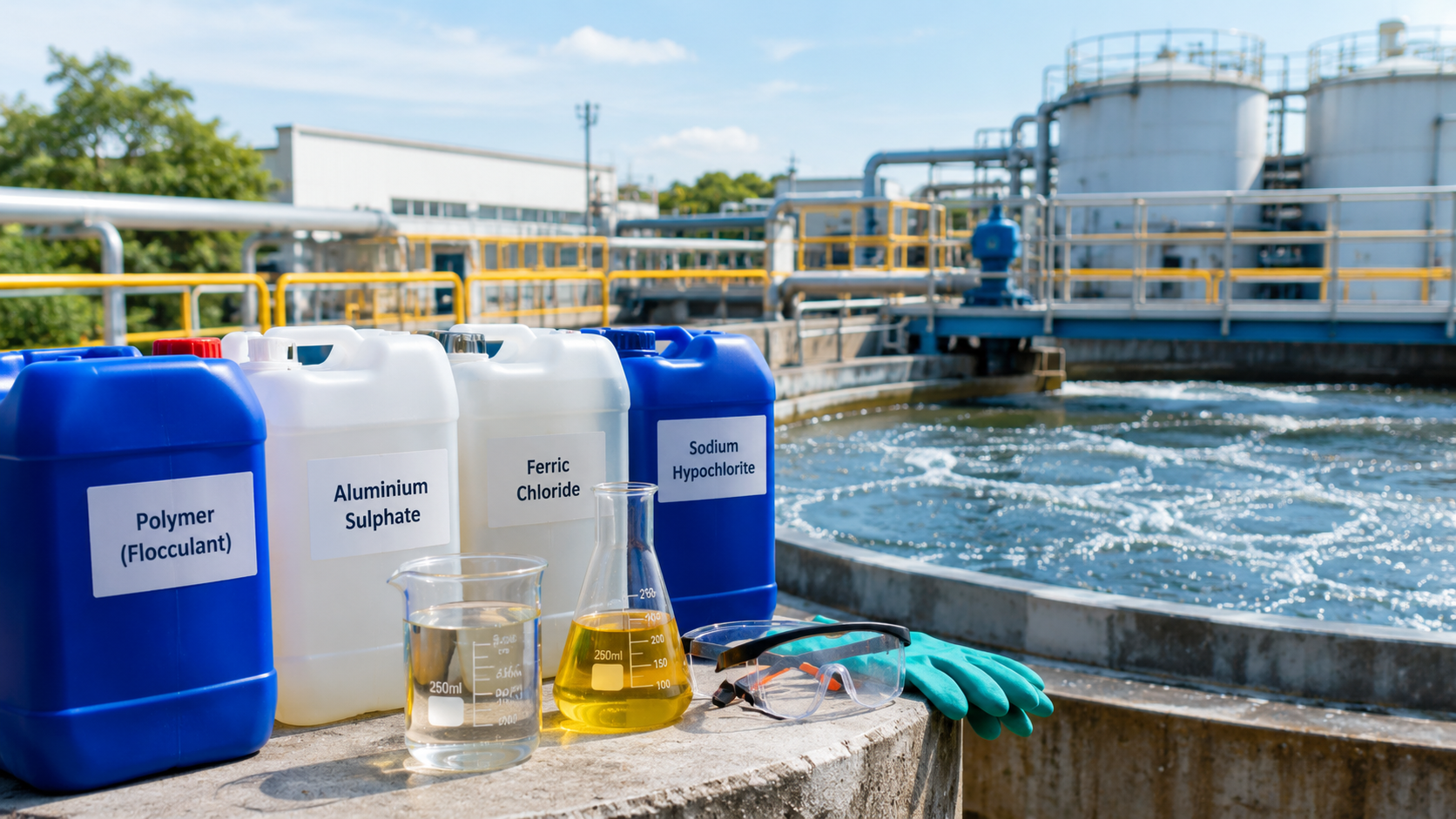
In industrial effluent treatment, aluminium sulphate and ferric chloride are examples of coagulants that can help destabilise suspended particles under suitable conditions. Selected polymers may then support floc formation and separation. Sodium hydroxide serves a different purpose: operators may use it for pH adjustment where the process design calls for an alkali. None of these products is a universal substitute for the others.
Consider a metal-finishing facility with variable rinse-water composition. Samples taken during different production activities may respond differently to the same treatment programme. The facility’s qualified treatment team could use controlled jar tests, relevant laboratory analysis and a supervised plant trial to compare options. It should assess clarified-water quality alongside sludge generation, chemical compatibility and downstream treatment performance.
Universal Lab’s industrial and water treatment chemical range lists products including aluminium sulphate, ferric chloride, ionic polymers, sodium hydroxide and sodium hypochlorite. These listings establish possible product enquiries, not suitability for a particular effluent, grade or operating condition.
Trend 2: Assess sustainable formulations without relying on green claims
A more sustainable treatment programme must still deliver reliable water quality. Buyers may investigate lower-phosphate formulations, alternative coagulants or reduced chemical consumption, but terms such as ‘eco-friendly’ and ‘biodegradable’ do not explain how a product will perform in a specific plant. Credible comparisons require relevant evidence and clearly defined boundaries.
For instance, a replacement coagulant might achieve the same suspended-solids removal with a different dose. That alone does not demonstrate a smaller environmental footprint. The factory should also consider any additional pH adjustment, sludge volume, residual chemicals, packaging and transport implications. In a cooling circuit, the assessment must account for scale, corrosion and biological fouling as well as the quality of discharged water.
A practical trial would compare representative water samples under comparable conditions, using agreed quality indicators rather than an assumed percentage saving. Product-specific evidence should support any biodegradability or environmental claim. Where the proposed chemical changes the process, the operating team should approve and document the trial before implementation.
The non-profit Alliance for Water Stewardship (AWS) offers a broader framework for understanding a site’s water use, impacts and shared catchment challenges. Its water stewardship approach helps explain why responsible water management extends beyond choosing a different chemical. The framework does not, by itself, certify a particular treatment product or establish regulatory compliance.
Trend 3: Use digital monitoring to make chemical dosing more consistent
Digital monitoring adds value when operators can act on dependable measurements. Instruments can reveal changes in pH, conductivity, flow or other application-specific parameters. A well-designed control system may use these signals to support dosing decisions, identify abnormal conditions and preserve useful operating records.
However, online readings are only as reliable as the sensor installation, calibration and maintenance behind them. Engineers must also define control limits, response delays and fault behaviour. Automating an unsuitable treatment programme will not correct the underlying chemistry.
Take an open cooling tower as an example. As water evaporates, dissolved minerals become more concentrated. A conductivity controller can help manage blowdown, while a separate treatment programme addresses scaling, corrosion and microbial risks. The US Department of Energy’s cooling-tower management guidance explains these connected operating considerations. Its guidance is a technical reference, not a replacement for a site-specific design or Malaysian requirements.
Before approving a monitoring upgrade, ask which measurement drives each control action, how the operator verifies unusual readings and what happens during sensor failure. Any changes to automated chemical feed should undergo an appropriate engineering and safety review.
Trend 4: Distinguish wastewater discharge treatment from water reuse
Water that meets an applicable discharge requirement is not automatically suitable for reuse. An industrial effluent treatment system may aim to reduce pollutants before discharge. A reuse scheme has another objective: to deliver water that meets the quality demands of its next application. The second goal can require additional treatment, monitoring and safeguards.
Before discussing membranes, disinfectants or specialty formulations, map the site’s water balance. Identify where water enters the plant, which processes change its composition, how treatment residuals are handled and where reclaimed water might be used. This prevents teams from confusing a water-saving ambition with a technically feasible reuse plan.
Consider a factory evaluating treated effluent for a non-product-contact utility. Its engineers would need to verify the required water quality, compatibility with downstream equipment and any relevant hygiene or operational conditions. If membrane treatment forms part of the proposal, residual oxidants, scaling tendency and fouling potential also deserve attention. Treatment chemicals must work with the entire process rather than undermining the next treatment stage.
For applicable industrial effluent discharges in Malaysia, the Department of Environment’s Environmental Quality (Industrial Effluents) Regulations 2009 provide an authoritative starting point. The DOE also publishes industrial guidance on effluent characterisation and performance monitoring. The responsible personnel must confirm which obligations, discharge conditions and approvals apply to the facility. A chemical purchase cannot establish compliance.
Trend 5: Specify high-purity applications separately from general water treatment
High-purity process water and industrial wastewater require different specifications. Electronics and precision-manufacturing operations may be particularly sensitive to trace impurities in certain process steps. By contrast, an effluent treatment plant may prioritise pollutant removal and discharge control. A chemical grade suitable for one duty should never be assumed acceptable for the other.
The purchasing team needs to specify the intended use, required purity, allowable impurities and relevant packaging or handling constraints. Where the application demands it, batch-specific analytical evidence can help confirm whether the supplied material meets the agreed specification. A Safety Data Sheet describes hazards and safe handling; it does not serve as a substitute for analytical quality data.
For example, an electronics factory may use an industrial-grade alkali in an effluent treatment system but require much tighter contamination controls for a separate production process. Buying both materials under the generic description ‘sodium hydroxide’ could create an avoidable procurement risk. Engineers should approve the required grade before purchasing.
Universal Lab lists industrial, laboratory and electronic-grade chemical categories. Buyers should confirm the exact product, current grade, packaging and available quality documents with the company rather than infer them from a broad catalogue listing.
Trend 6: Make chemical traceability and safe handling part of procurement
A reliable chemical supply arrangement includes more than product availability and unit price. It must identify the correct substance or formulation, agreed specification, handling requirements and the documents needed by the purchasing, quality and EHS teams. Consistency matters because a change in concentration or contamination profile can affect a sensitive process even when the product name remains the same.
Malaysia’s Department of Occupational Safety and Health (DOSH) explains the Classification, Labelling and Safety Data Sheet of Hazardous Chemicals (CLASS) Regulations 2013. The framework addresses supplier responsibilities for hazardous chemicals supplied for workplace use, including applicable classification, labelling, packaging and safety information. Site personnel must assess the specific products and work activities against the requirements that apply.
Consider a factory changing its pH-adjustment chemical. Even if both products serve the same treatment objective, the facility must review storage compatibility, transfer equipment, personal protection and operating procedures. The relevant SDS supports hazard communication; laboratory and process evidence must establish treatment suitability. Neither document replaces a qualified risk assessment.
For further reading, Universal Lab explains the implications of chemical quality consistency and discusses chemical safety considerations for Malaysian industry. These supporting articles complement, rather than replace, the official regulatory sources.
How should a Penang manufacturer compare treatment chemical suppliers?
Give every shortlisted supplier the same application brief and compare proposals on an equivalent basis. A low unit price can conceal important differences in chemical concentration, delivery arrangements, packaging, compatibility testing or the services included. A sound purchasing decision therefore examines the complete treatment duty and what each supplier can substantiate.
Start with the system type, recent water-analysis results and the operational problem. Then document the existing chemicals, treatment equipment, expected demand and any relevant discharge or product-quality requirements. Suppliers can use this information to establish whether their listed products warrant further evaluation.
| Information to prepare | Why it matters | Question to ask |
|---|---|---|
| System duty and treatment objective | Cooling, wastewater and process-water systems need different chemistry. | Which product and grade match this application? |
| Representative water analysis | Variable water quality can change treatment performance. | What testing is needed before selection? |
| Existing chemicals and equipment | Materials and downstream processes may limit compatibility. | What compatibility evidence is available? |
| Product and safety documents | Procurement, quality and EHS require different records. | Which specifications, SDS and batch documents can you supply? |
| Commercial and support scope | Quotations may exclude trials, handling equipment or technical services. | What is included, excluded and subject to confirmation? |
Where testing is appropriate, agree on the performance criteria before the trial begins. Depending on the process, these might include treated-water quality, chemical consumption, sludge characteristics or stability under changing operating conditions. Record the baseline and the results consistently; a comparison made under different conditions may be misleading.
Universal Lab’s industrial chemical supplier guide provides additional context for evaluating sourcing and documentation. Confirm any proposed technical services, product grades and delivery commitments directly with the supplier.
What is the most practical next step for Penang factories?
Define the water-quality problem before approaching suppliers. Gather representative test results, describe the treatment process and establish what successful performance would look like. This allows the responsible engineer to identify realistic options and gives procurement a sound basis for comparing quotations.
Universal Lab & Chemical Supplies (PG) Sdn Bhd, established in 1985 and based in Simpang Ampat, Penang, publishes an industrial and water treatment chemical range alongside laboratory and electronic-grade categories. Its catalogue can help buyers identify products to discuss. Final chemical selection, grade, availability and any application-specific support still require confirmation.
Frequently Asked Questions
What should a factory do if its influent water quality changes between shifts?
Collect representative samples across the operating conditions, review the treatment plant’s monitoring records and ask its qualified team to investigate the variation. A chemical that works on one sample may not perform consistently across the full production cycle.
Can a supplier recommend a coagulant without water-analysis results?
A supplier can discuss possible product categories, but the final choice needs a clear treatment objective and suitable water-quality evidence. Representative testing and a controlled trial may be necessary before plant-scale changes.
Does an SDS confirm that a chemical meets a factory’s purity specification?
No. An SDS supports hazard communication and safe handling. The purchasing specification and, where required, relevant analytical or batch documentation establish the quality requirements for the intended application.
Should an industrial water reuse project use the same quality target as discharge treatment?
Not automatically. The reuse destination determines its own technical quality requirements, which may be more demanding or different from the applicable discharge conditions. A qualified team should verify the proposed reuse route and any necessary additional treatment.
What should buyers confirm when comparing water treatment chemical quotations?
Check the exact chemical identity, concentration or grade, packaging, product documentation, delivery terms and exclusions. If a proposal includes testing or technical support, confirm the scope and acceptance criteria in writing.
Discuss Water Treatment Chemicals for Your Penang Facility
Whether you manage an effluent treatment plant, cooling-water circuit or specialised process-water application, begin with your system details and water-analysis results. Review Universal Lab’s water treatment chemical listings, then contact Universal Lab to enquire about product specifications, grades, documentation and availability. Have the responsible technical personnel review any application-specific chemical or process changes before implementation.